Grow your Own Organically

November 29, 2021

As part of The Diggers Club's commitment to the environment, Heronswood, The Garden of St Erth, and our production nursery are all certified organic gardens.

For us gardeners, this means we need to observe strict guidelines which are annually audited to maintain this accreditation.

areas of the garden are covered in this certification including food production and ornamental flower beds.

That all sounds a bit daunting and official but really it comes down to home grown common sense!

The fundamental key to organic gardening is the building of healthy living soils.  Just as we are starting to realise that gut health is imperative to personal well being and immunity in humans, so too is soil health the building block of a healthy productive garden.

Conventional Gardening VS Organics

The differences between modern, conventional gardening and that of organic gardening practices can begin to be explained by comparing the action of chemical fertilisers with organic composts.  Mineral fertilisers are chemical based additives and are designed to feed plants, not the soil.  They release nutrients very quickly so gardeners see rapid results but over time this can lead to a build up of salts and chemical residues that can be harmful to soil life.

Composts, on the other hand, enrich and condition soils.

They provide plants with nutrients via the addition of a medium that is jam packed with beneficial microbes and fungi.  These life forms incorporate themselves in the soil and form an association with the plants roots to enable the uptake of nutrients.

In conventional gardening practice, pests, diseases and weeds are largely controlled by the use of poisons.

By contrast, an organic garden employs a clever use of strategic planning, such as attracting beneficial insects to feast on bad bugs or non-toxic inputs such as flame weeders to deliver the same results; all of which respect the soils and the life within them.

How we garden organically at Heronswood

Each day at Heronswood, we adopt organic practices to keep the gardens in optimum health.

Integral to our daily work is the making of compost.  Admittedly sometimes it is far from text book compost but the inclusion of this bio active mulch/compost enlivens the soils and reduces our reliance on chemical based, nutrient inputs.

In areas where aesthetics aren’t such a priority we ‘chop and drop’ prunings around the plants.  This provides a wonderful mulch which in turn delivers nutrition to the soil, increases the organic matter and improves the soils water holding capacity.

grow organically

Dealing with weeds organically

Most of our weeds are composted.  For those pesky ones that could spread around the garden; like oxalis, kikuyu and false onion, we are starting to make weed teas.

Using a small wheelie bin we drop in the weeds and then add some water.  We leave them to ‘drown’, stirring often to keep it aerobic; and not so smelly!  The sludge can be safely added to the compost and the liquid being a nutrient tea that can be applied in diluted form back to the beds from which they came.

For weeds in paths and driveways we scrape or hoe them out, pick them out manually or use the flame thrower to destroy them on the spot. 

Dealing with pests and diseases

The key to pest and disease control is really observation.  Being quick off the mark and seeing any changes to plant and soil life is critical in organic practice.

It's so much easier to deal with a small outbreak of pests than a complete infestation.  Also understanding and being able to recognise which critters are the bad guys is pretty important.

Companion planting to encourage beneficial insects and of course bees is also very helpful.

Being so cold this winter, I felt that no bug in its right mind would be around, but no such luck!  For some reason a little enclave of aphids found a home, a haven even, in the alliums in the parterre.

Repeated applications of pest oil and neem sprays have knocked the population and at least I have confined it to one bed!

Feeding plants organically

Apart from compost, for plant nutrition we do use organic pelletised manures on a seasonal basis and a seaweed liquid to reduce transplant shock.

In the food production areas, crop rotation is employed and included in that is the planting of green manure crops.

Green manures are integral to soil health — they rest the soil, increase organic matter and nutrient levels and encourage microbial activity.

Gardening organically is a common sense approach to growing, and the good news is that no major skills are required.  It is affordable as almost all composts, pest and disease controls can be home made.

It is safer as chemicals and toxins are not being incorporated into your soils and your food and it is satisfying as you start to watch and learn what is going on outside — the rewards are endless.

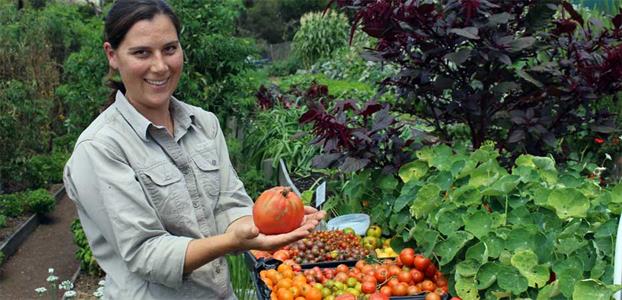
Visit Heronswood to see our five food gardens, including our Herb Garden and Food Border.  This is the biggest collection of food plants in Australia.