15 urban trees vital for cooling our cities
Why tree planting needs to start on a massive scale.

The cities and towns of Australia are custodians of vast urban forests. The City of Melbourne alone has 70,000 trees in its streets and parks.
Australia’s great avenues of street trees and parks is largely the legacy of Colonial visionaries who set aside park land and planned boulevards to be the lungs of our cities.
Their vision is even more remarkable given they did this at a time when Australia's forests and land seemed limitless.
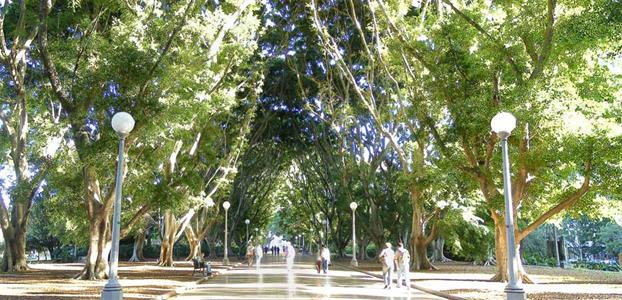
The trees planted throughout the 19th and 20th centuries have created landscapes we love today, in Melbourne Great Elm avenues, the Hill's Fig avenue in Sydney's Hyde Park, Adelaide's Waite Arboretum to name a few. They seem such a permanent part of our landscape.
The problem is they are under threat from climate change, ageing and population growth. To ensure our urban forests survive into the future we need a new vision for the next hundred years.
The City of Melbourne has developed an Urban Forest Strategy that is a blueprint for ensuring that trees thrive in our cities. For us as home gardeners it provides insight into how we can manage our own slice of the urban forest, in particular tree selection.
Our urban trees have been through a lot; they are old, their climate has grown hotter and drier, their surroundings have become more built over and impermeable to water. As a result they are dying. The City of Melbourne will lose 44% of its trees within the next 20 years, that is 30,000 trees! Landscapes like Fitzroy Gardens would be unimaginable without their monumental tree avenues, likewise our treed boulevards have masked the destruction and ugliness of much of our built environment.
The effect of tree loss will be more than visual; trees provide a vital role in cooling our cities and mitigating the urban heat island effect cased by the hard heat absorbing surfaces of our cities. The aim is to increase the canopy cover in the city from 20% of the public area to 40% dramatically reducing the heat effect.
Tree planting needs to start on a massive scale. Not just any trees but the right trees for the right space. A key aspect of the strategy is developing a selection matrix. Diversity is a notion dear to Diggers' hearts. Urban foresters now realise that monocultures put our landscapes at risk.
The more diverse the forest is the more resilient it is against pests and diseases, changing climates. This include both species diversity but also diversity of age. Regular annual tree planting and removal should prevent the mass aging and decline that is evident in the urban forest today.
Melbourne's treescape is dominated by only 3 species Planes, Elms and River Red Gums. Reliance on any one family of plants puts our forest at risk. At present 43% of our forest is from the Myrtle family mainly Eucalypts. Myrtle rust could wipe out nearly half our forest. The aim is that by 2040 no more than 5% of trees will be of any single species, no more than 10% a single genus, no more than 20% any one family.
When selecting the old “native vs exotic” chestnut (or should that be gum nut) arises. The strategy acknowledges that urban landscapes are highly modified and very challenging for plant growth. Plants that are indigenous to the site may no longer be adapted to harsh urban conditions. The focus should be on plants that grow well on the site and fit the purpose – providing shade. That is we should be colour blind when selecting trees and grow the best one for the job. Interestingly, Australian rainforest trees such as Kauri, White Cedar, Illawarra Flame Tree, Wheel of Fire Tree and Podocarpus feature in Melbourne's master planting list.
What is important when selecting trees is their drought, heat, pollution and wind tolerance; their longevity and pest resistance. Interestingly their potential as an allergen is also taken into account. Anyone who has been affected by the onslaught of the flowering plane trees will shout “hallelujah”. The tree strategy also highlights that size matters. One large tree is more valuable in terms of climate mitigation, habitat and public well being than several smaller trees. It is important that we maintain large trees in the urban landscape.
What does this mean for the home gardener? We all play our part as foresters of the great urban forests of Australia. When planting trees in our backyard we need to select species that will suit our changing climate for the next 100 years, not just the species that have worked in the past. We also need to contribute to the diversity of species. Grow something out of the ordinary as it will add to the resilience of our forests. Succession planning is also vital don't wait for your tree to die to think about its replacement.
Don't be stuck on issues of native vs exotic or indigenous plantings. Grow the tree that best suits your environment and purpose. Most of all encourage our local communities to start looking at our urban forests not as legacies from the past but some thing we must reinvent for the future.
For further info visit the City of Melbourne's website and search “urban forest”: www.melbourne.vic.gov.au
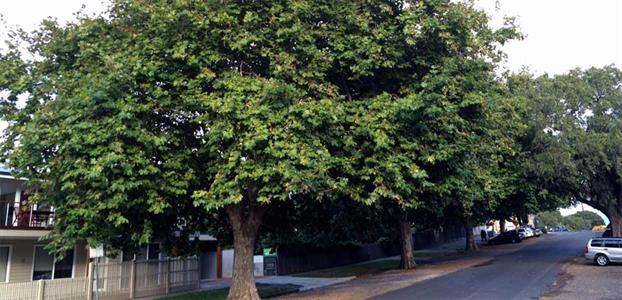
PLANE TREES SHADE THE ROAD AND FOOTPATH