Creating an Edible Landscape

Challenges of combining beauty and functionality in the garden.
Creating an Edible Landscape

Australian cities are biting the hand that feeds them.

Our burgeoning suburbs are converting bounteous market gardens into manicured sterility. The gardens that replace these food bowls are either purely decorative or hardscaped outdoor rooms.

Edible landscaping is not a fringe nicety; it is a powerful tool for minimising the environmental footprint of our suburbs. It offers all the benefits of growing your own food — the food safety, the energy, water and money savings — all wrapped in a beautiful, socially acceptable package.

The skill in edible landscaping is seamlessly combining beauty and function. Hay bales, twine, cabbages and spinach strewn across a front yard may be productive but it will not win hearts and minds.

A visit years ago to fruit guru Louis Glowinski's garden switched me on to the power of edible landscaping. The design was unremarkable and that was the genius, a front yard that looked more or less like its neighbours but you could snack on the guavas.

The challenge with edible landscaping is to move beyond the functional. The parterre at Heronswood is beautiful but is very much a beautiful vegetable patch; in the edible landscape the food function is subsumed by the visuals of foliage, flower and fruit.

It is a garden that incidentally contains 80% or more edible plants. Your focus should be on form, colour and texture, not fertiliser regimes and harvest schedules. Although the edible landscape is much touted there are few really convincing examples and this is the thrill of landscaping with edibles — we are creating a new branch of gardening.

The starting point for edible design is to ignore your stomach and look at these plants afresh, as if they were purely ornamental.

Forget the juice, an orange tree, with scented blossom and colourful fruit is one of the most ornamental small trees. Forget the vegetable gardener categories, you need to see the plants divided into form and colour.


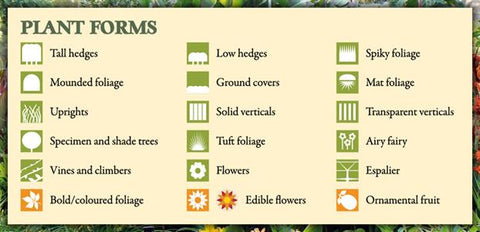
plant forms chart

Plant forms

Mounding forms — Guavas, Myrtle, Feijoa, Calamondin/Kumquat, Midyim Berry.

Vertical forms — Canna edulis, Gingers, Sugar Cane, Bamboo.

Airy Fairy forms — Asparagus, Bronze Fennel.

Mat forms — Alpine Strawberries, Sun Rose, Rock Samphire, Society Garlic, Chives, Golden Oregano, Sage Thyme.

Bold foliage — Canna, Rhubarb, Angelica, Amaranth, Babaco, Banana, Cardoon/Artichoke, Golden Fruit of the Andes.

Adding colour

Bold/Coloured Foliage — Blood Sorrel, Amaranth, Perilla, Variegated Society Garlic, Rainbow Chard.

Edible Flowers and Flowering Edibles — Nasturtium, Runner Beans, Pomegranate, Citrus, Rosella, Guava, Feijoa, Jerusalem Artichoke, Stone Fruit, Quince, Daylilies.

Ornamental fruit — Tamarillo, Babaco, Citrus, Pomegranate, Chillies, Persimmon,
Quince, Olive.

Plants for formal hedging — Citrus, Olive, Guavas, Myrtle, Avocado, Natal Plum, Bay, Camellia sinensis (Tea), Macadamia, Rosemary.

Climbers — Kiwifruit, Kiwiberries, Pepino, Malabar Spinach, Grape, Hops.

More than giving looks and food the edible landscape can provide shade, privacy and divide space in your garden. If you haven't done so, please dig out your Box hedging and plant a Chilean Guava hedge immediately!

Focus on perennials. The general garden bed with issues of shading and competition is not the best place for most gross feeding leafy annuals. Likewise root vegetables will require digging and leave your garden with “holes”.

Annual vegetables are best kept in an ornamental potager style garden. From experience with our food border at Heronswood an over reliance on annuals can prevent the development of a mature integrated garden bed. It is best to use annuals as fillers or for accent colour.

Don't banish the purely ornamental, we need both bread and roses. The edible landscape is not a purist landscape. For the utilitarian think of it as home grown cut flowers.

Maybe avoid the poisonous. Remember Dahlias were originally imported to Europe with potatoes as a potential food crop. Flowers like roses and lavender likewise cross the ornamental culinary divide.

Don't be too concerned about self-sufficiency, the edible landscape is more the place for seasonal delights, rare and exotic treats than staples. If you want a formal look you may sacrifice a loss of fruit for the joy of a tightly clipped kumquat hedge.

So get out and have a look at your landscape, the front lawn, that narrow bed along the drive, the front hedge; how could you integrate edibles beyond the vegetable patch? Experiment and play your part in the edible landscape revolution.