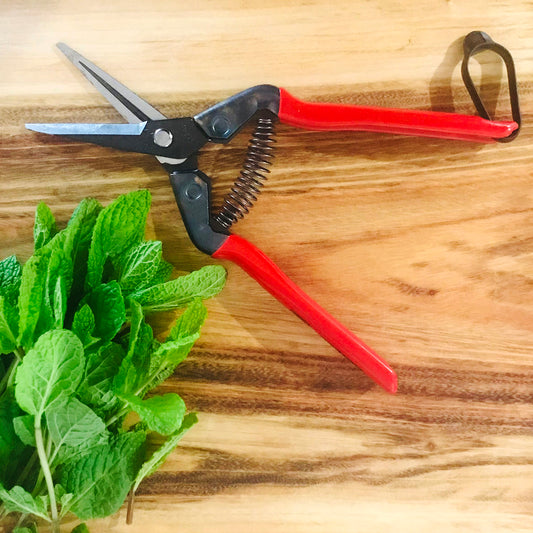
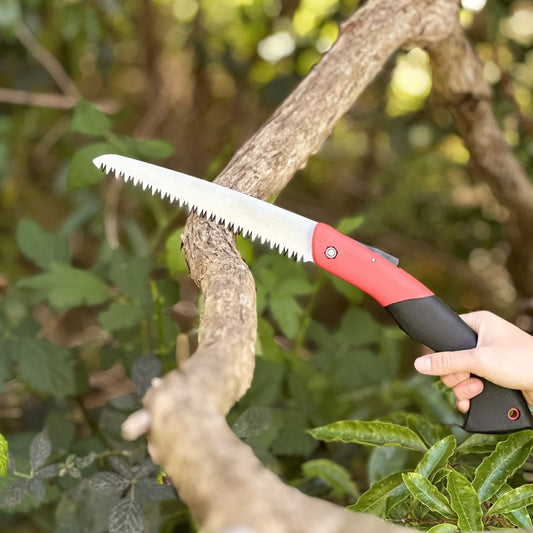
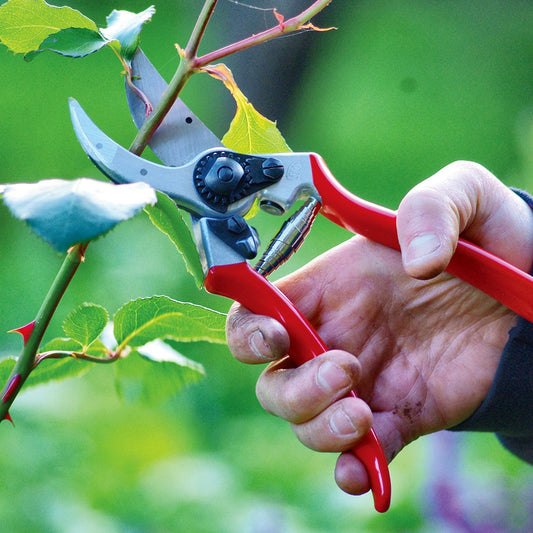
When we say a plant needs a good prune we are not speaking for the plant. Indeed the visionary poet gardener Masanobu Fukuoka shunned pruning altogether in favour of “do nothing” farming.
Those who have seen the truck loads of green waste generated by my gardening will find this an odd way for me to begin writing about pruning. What I want to emphasise is pruning is a way of cutting and training a plant to achieve desired outcomes – it is not an end in itself. We prune for reasons and goals of our own making, it is not an innate need of plants.
That being said pruning can be a powerful tool for achieving these goals, be they larger fruit, better flowering, pleasing form. Everyone has their own pruning style from the romantic in pursuit of natural form to the controlling clipper in pursuit of formal geometry. Wherever you fit in this spectrum, for success you must base your personal pruning style on an understanding of both why you are pruning and how a plant will respond.
Why prune?
Any pruning involves the wounding of a plant; poorly considered pruning can ruin the health and beauty of a plant.
Before we pick up secateurs or saw we must ask “Why prune?” If an aging tree with falling limbs hangs precariously over a path or seat, consider moving the seat or rerouting the path before reaching for the chainsaw.
Proper plant selection and spacing can reduce the need to prune by growing a suitable plant with a form and size matched to its purpose and location. One minute reading a plant label when purchasing a plant can save hours of pruning.
There are many good reasons to reach for saw and secateurs. The most obvious and less invasive is the removal of dead or damaged branches to make a tree safe and reinvigorate shrubs. Pruning is a key tool for removing diseased or pest-infested growth; removing fungal infected leaves and swollen citrus branches harbouring citrus gall wasp.
Pruning can extend the life of many plants. Annual clipping of lavender certainly keeps it thriving. Hedge pruning creates shapes and provide dense screening.
Pruning can help produce an even crop of larger fruit or flowers by allowing better light penetration and directing growth from leaf to fruit production. We can shape the direction and extent of plant growth by pruning. Use the direction of buds or stems to guide your cut. The direction of the highest bud will shape the direction of the new growth. Pruning can compensate for root loss when we are transplanting, reducing water loss.
Plant responses to pruning
Remember a plant is a living thing, you are not simply cutting lumber to size, it responds to being cut. The true power of pruning lies in these responses.
The way a woody plant responds to pruning is partly determined by its natural pattern of shoot growth. Initially, a plant begins with a single growth point the apical or terminal bud. As the shoot develops nodes are formed where leaves are attached. Plants have a vested interest in growing upward towards light, through a process called apical dominance the growth of side or lateral shoots is controlled and inhibited by the hormone auxin produced by the terminal bud. As auxins move downwards apical dominance is strongest in vertical branches and diminishes as branches become more horizontal. By pruning we either suspend or selectively promote apical dominance.
Heading pruning breaks apical dominance by removing ends, tips or tops of shoots or limbs. This is what we are doing when we are hedging, tip pruning or tree lopping. It results in a more compact dense plant form. As plants naturally reassert apical dominance hedging and tip pruning are constant routines in the garden that should start early and be done often.
Lateral shoots thrive and latent buds hidden along the stem are freed to spring into life. Heading can reduce a shrub initially but result in a burst of new growth. It usually disrupts a plant's natural form and highlights the gardener's intervention; perfect for formal controlled effects. In fruit pruning it keeps fruit within reach and promotes fruit bearing spurs.
In thinning, the apical dominance of a plant's main stems is preserved; whole stems are selectively removed to their base and regrowth is suppressed. Thinning improves light penetration for fruit and flower production, directs growth and can enhance the natural form of a plant.
This type of pruning is particularly suited to shrubs with graceful arching form like Viburnum or Spirea or berry canes. One of the most unsightly forms of pruning, especially in deciduous shrubs, leaves stubs at random heights erupting in a confusion of spindly growth. In the main, ornamental trees should only be pruned by thinning to preserve their natural form.
Selective thinning inhibits regrowth and in the end is more effective at controlling tree growth than lopping that promotes rampant regrowth. Selective pruning is also a great way to restore overgrown tired shrubs by selectively removing older branches over several seasons.
All pruning wounds a plant. Good pruning reduces the adverse effects of wounding to a plant. The smaller the wound the better; for this reason early formative pruning of trees is crucial for sound structure. The wound we make today with secateurs if left would be made with a chainsaw in 10 years. Little pruning often creates less plant stress. It also means your garden beds avoid the ‘holes’ created by drastic pruning done sporadically.
Pruning trees
To know where to cut we need to know how plants recover after pruning. This is particularly important for trees. Plants respond to wounding in fundamentally different ways than us. Many mistakes in pruning are based upon the misunderstanding that plants heal like an amputated limb or a cut finger. Woody plants do not heal, they seal. That is, they do not replace or repair injured tissue but create barriers around a wound to slow the spread of decay. They do this by plugging the vascular system and developing a layer of cambium over the wound. The cuts we make on a woody plant will always open the plant to decay.
To allow plants to seal we need to be precise in our cuts. For small branches an oblique cut just above an outward facing bud is ideal. In some plants like figs and mulberry that tend to dieback you may need to allow for this in positioning your cut. For trees, a noticeable collar or ridge where branches attach to the trunk is vital to protecting a wound.
When cutting tree limbs, cut as close as possible to the ridge, following its angle without damaging it. It may look neater to flush-cut a limb but remember you are a gardener, not a carpenter. Likewise avoid a stub that is too large to seal over. Take some time and look at large tree wounds that have sealed. This little knowledge will make you despair at the needless ugly stumps that are routinely left by “tree loppers”. These stubs often sprout vigorous poorly attached branches that undo the initial pruning anyway.
When to prune
Several factors influence when to prune. Pruning initially stresses a plant but also promotes a flush of tender shoots. Seasonal extremes of heat or frost can damage new shoots, it is best to prune so that new shoots arrive after or well before frost and not in the middle of a heat wave. Stone fruits particularly apricots and cherries are susceptible to Bacterial Gummosis; it is best to prune these in summer to allow wounds to seal before winter when they are most susceptible to attack. Knowing the flowering and fruiting period of a plant is crucial to correctly time pruning to avoid a disappointing harvest or display. You don't want to cut off next years flower buds.
Basically you need to know if they grow on new wood (formed during the current growing season) or old wood (the previous seasons growth). As a general guide but for deciduous shrubs in particular, spring flowering plants grow on old wood so prune after flowering to allow for next years growth to develop.
Summer flowering shrubs that form on spring growth are pruned in winter as the buds swell. Evergreen shrubs can generally be pruned after flowering or if fruiting after harvesting. Always know your plants flowering, fruiting and growing periods before you prune.
Still you can't always dither waiting for the perfect time; as Christopher Lloyd advised novice gardeners the “best time to” is “when you're thinking about it; when you're in the mood.” It is no disaster to lose a season's flower or fruit if you gain a better shaped plant in the long term.
I encourage you to follow your own pruning path. Be sure about what you want to achieve by pruning and know how your plants will respond. Once you are clear about this, go for it. Don't mistake timid pruning for careful pruning – sometimes you will need to be bold.
Definitely read all you can about the plants that relate to you, there is a lot of information about fruit trees and cane fruit that can set you on your way. But don't be intimidated by texts with complex diagrams or become obsessed with counting the sixth bud on every Wisteria stem before you cut it.
Pruning is more of a craft than a science you will learn through doing. You will make mistakes but you will also make discoveries.