
The Persian Rose
Marcus Ryan visits Shropshire to explore the creation of new roses from the desert.

Marcus Ryan visits Shropshire to explore the creation of new roses from the desert.
Scrambling amidst rocky scree of the desert steppes, the suckering stems of the Desert Rose are clothed in striking silver leaves.
Petals unfurl from bristly buds to reveal bright golden flowers, each with bright reddish central markings. Although sun hardened, these stunning plants become difficult in the garden. So for a select group of breeders, these evocative markings have inspired an obsession: to recreate this desert jewel as a new garden rose, whose distinctive Persian eye carries all the sumptuous beauty of peonies and poppies.
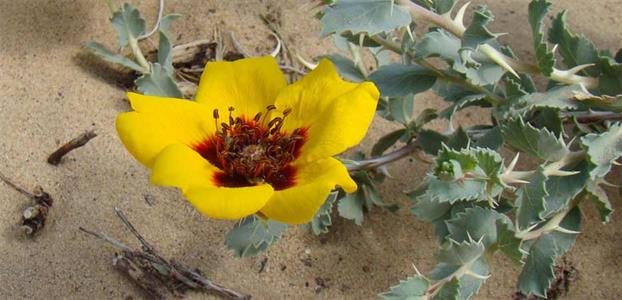
THE DESERT ROSE SPECIES, ROSA PERSICA
Far from the arid and rocky home of Rosa persica, begins Englishman Chris Warner’s tireless efforts to bring the desert rose into our gardens. For the past 30 years, Chris has striven to replicate the beauty of this Persian desert rose. Located in Shropshire, a short drive from the property of David Austin roses is the home and nursery of Chris Warner.
Chris has little interest in floribunda and hybrid teas, “striving for plants with personality rather than a stalk with a flower on it, which is just not graceful”. Yes, his roses are modern shrub roses, but strong disease resistance makes them the best option where fungal problems of black spot may have caused you problems in the past. Disease resistance, heat tolerance, fragrance, repeat flowering roses with autumn hips are at home in the flower border.
In his nursery every year, three to four thousand seedlings are raised from deliberate crosses, mostly involving the blood of the desert rose: and these qualities are distilled and improved each season, to create garden friendly Persian roses. “The eye must express itself” so his selections have “…no more than 18 petals; otherwise the eye loses its impact”.
And so begins his daily ritual: potential parent flowers are identified, and their flowers are emasculated, removing most of the petals to prevent accidental cross pollination. Pollen is harvested and stored under refrigeration.
Pollen from the potential paternal parent is placed in the glasshouse to warm.
After lunch begins the pollination: nimbly, upon the tip of his finger, a thousand grains of pollen are collected and swiftly and surely applied to the receptive stigma of the maternal parent.
And within this pollen, are 20,000 limiting characteristics, ultimately determining the rose through defining every factor imaginable – length of flower, colour stability, etc. And these crosses happen before my eyes, as Chris plays God with potential, painting pollen to create his masterpieces. Perhaps, in this moment, the rose of the year 2020 was just created.
From his breeding, the resulting seed is germinated in the same glasshouse, and young seedlings are pricked out to a communal bench for further evaluation.
These flower in their first season, and so begins the thinning process. Key selection criteria include disease resistance, flower colour and form. And from several thousand candidates, perhaps a handful remain.
Even before the promise of a flower, plants showing any signs of disease susceptibility are destroyed ruthlessly. And amongst them, other indicators attract his interest: lower lateral shoots give promise of repeat flowering.
Yes, he is in love with the evocative markings of the desert rose, and central to his breeding program is the goal to introduce this to garden hybrids. Regardless of flower, his aim is to develop a disease resistant rose, scented and repeat flowering. “Anything that doesn't repeat, doesn't get propagated”, he proudly states whilst showing me through his glasshouse.
Promising hybrids are planted out into the field, initially on their own roots. Here they are assessed for volume of bloom, and clean foliage without disease. It’s a tough life for rose seedlings under the scrutiny of Chris Warner; “Many are called but few are chosen” he recites.
And with patience and dedication, the first persica hybrids were produced, affectionately named Tiggle and Tingle. Although not garden roses, this duo provided the genetics to enable a higher success of deliberate crosses.
And soon the Eyeopener series was born.
One of the first releases, Eyes for You has just been awarded the 2015 Rose of the Year at the Hampton Court Flower Show. Bright as a Button is one of the best repeaters, awash with scented pink flowers, each opening to reveal a dark burgundy eye and golden buff of stamens.
Although without the mysterious Persian eye, Blue for You is perhaps the bluest rose available, with layers of mauve petals aging to a soft slate blue. Bullseye shows the largest eye, becoming a dark red target central to each flower.
And after thirty years of breeding, he is still enjoying it as much as ever. “You see a new flower, peel back the petal… will it have the magic eye?”
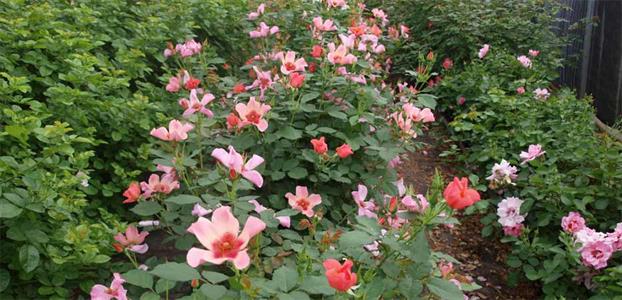
FOR YOUR EYES ONLY