Cottage plants were the purest forms of flowers before modern bedding plants took over.
Cottage plants were the purest forms of flowers before modern bedding plants took over.
A cottage garden is a cheerfully disordered plot overflowing with flowers, vegetables and fruit.
This exuberant garden style developed in rural England, centuries before gardeners could ever buy seeds or plants or even food from shops. Cottagers would collect the seeds and swap cuttings to create beautiful, but unsophisticated, gardens in harmony with their houses and towns.
Cottage gardening is the purest form of flower gardening, and the most joyful. Thriving throughout England
today, cottage gardens are a testament to the cottager’s art. The style has been transplanted to America and Australia, and defined as a garden form in which flowers predominate over form and structure.
As a garden style it preceded industrialisation, but as people moved into the cities, plant-breeding merchants began to distort and vulgarise cottage flowers, creating crude colour combinations, the most offensive element in the modern suburban garden.
Cottage flowers are unpretentious and they harmonise more easily in gardens than the modern, enlarged, ‘look at me’ bedding plants. The Americans and Dutch are the drivers of modern plant breeding, creating the hybrids and genetically modified vegetables and flowers that have done so much to destroy the quality of our gardens.
Elements of a cottage garden
English cottagers had to grow their own food, so cabbages and leeks were grown in the same beds as sweet peas and roses, creating the beautifully diverse and largely pest-free gardens that we aspire to today.
Apples and pears bore beautiful blossoms and fruit (there were no fruiterers!) and their branches provided support for clematis to climb towards the sun. The summer garden relied largely upon perennials but also included some annuals, all swapped across the fence, so that visitors were always struck by the harmonious similarity of neighbouring cottagers’ gardens.
The creation of an artistic cottage garden can only be achieved by planting subtle flowers that harmonise with each other. Flowers that are bred for cutting and display in a vase are usually best grown in separate production areas like some vegetables, where the gaps left after cutting go unnoticed. Bold bedding plants and unimproved cottage plants rarely combine well, just as arid native foliage looks awkward with lush, green foliage.
Cottage gardening today
Nostalgia for the garden of pre-industrial simplicity is the last reason to grow cottage plants. Cottage plants are the purest forms of flowers – the ingredients needed to create our finest flower gardens.
Don’t be misled into thinking that these flowers are indigenous to England; almost all of them were brought back from America, Asia, Europe or Australia and then adapted to English gardens.
The English flower garden, which is the pinnacle of achievement for flower gardeners around the world, is no more native to the English countryside than ours. The Australian flower garden will emerge in the same way, as Australian gardeners adopt the flowers best suited to our climates and lifestyles.
Can a cottage garden be grown in suburbia?
Most Australian cottage gardens have developed in country areas and close to the coast.
In the suburbs, cottage plants display beautifully in front of historic houses and where natural materials, such as timber fences, local stone paving and wooden gates, complement the picture. But they can look ridiculous if the elements of our modern age, such as modern bricks, steel fences and aluminium letterboxes, are exposed.
The cottage garden containing flowers and vegetables is the garden form to choose for anyone who desires a self-sufficient, organic lifestyle.
Cottage gardens in the tropics?
The signature cottage plants need cooler winters than can be found in the subtropics, but they thrive without artificial water in southern Australia through cool, wet spring conditions.
Growing vegetables and flowers
Many vegetables that we grow for food have decorative and structural elements. Our spring cottage garden would be shapeless without the gigantic leaves of artichokes and the purple-headed cabbages, while parsley is the most ornamental vegetable and an essential plant in any cottage garden.
One of the first steps towards garden enlightenment is to be able to think outside the conventional plant categories and see plants, not as flowers or vegetables, but simply for their intrinsic form and beauty.
The modern suburban garden
The suburban garden, which developed after the Second World War, became a watershed of bad taste. Rejecting all the fine plants available and garden ideas that had preceded this garden style, suburban gardeners filled their gardens with showy annuals and shapeless shrubs, presuming anything new was an improvement.
Not all plants are equal. It’s what you exclude from a garden that defines its character. A garden of distinction can only be created by using plants that create harmony – gardenworthy plants that have good foliage, good form and, lastly, good flowers. Suburban gardens need restraint or they become commonplace.
Cottage garden styles can be achieved with the planting of free-flowing, abundant flowering annuals and perennials.
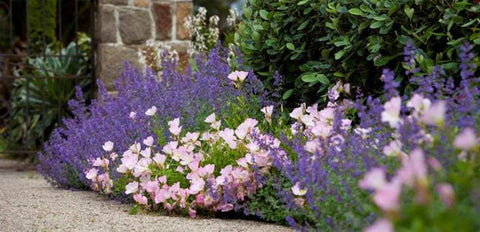
Here we have combined the vibrant floral blues/purples of Catmint 'Walker's Low' (Nepeta x faassenii) with the soft pink tones of Evening Primrose Pink (Oenothera speciosa 'Heronswood Pink').
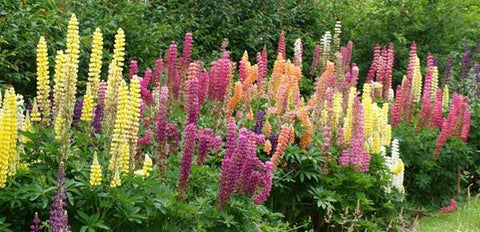
Ideal for a cottage garden, Russell Lupins (Lupinus polyphyllus 'Russell Lupin Hybrids') are clumping perennials with dissected fan-like foliage which give rise to towers of flower in every pastel shade imaginable.
They combine perfectly with poppies, catmint and roses.
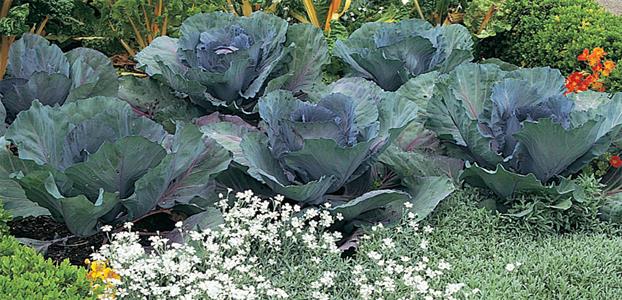
CABBAGES AND SNOW-IN-SUMMER COMPLEMENT THE COTTAGE GARDEN

