The most important decision a gardener can make is to choose the right trees to cool their garden. Trees and grasses expel water through their stomata on hot days, providing rain in forested areas and a 10-15°C temperature buffer in gardens during 40°C heatwaves.
So in our Heronswood garden, we sit in the shade at a pleasant 25°C rather than 40°C.
To help you choose your trees we have provided horizontal spread information, so you can avoid planting trees too closely or choosing trees that provide lousy shade, such as eucalypts.
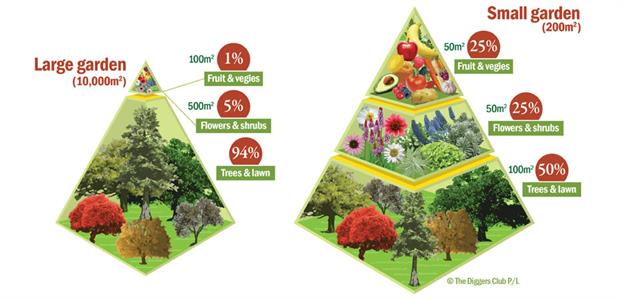
Now the big question is how much of your garden should be shaded by trees and how much should be evaporatively cooled by grass? Until your trees and lawns provide at least 50% of their area with shade then, in our experience, it will still be unpleasant to be outside in summer.
Whether trees take half of that area, i.e. 25% of that total or 40% of that total is a matter of personal choice. Once planted, trees require the least effort and lawns the most.
There are lots of other reasons to provide this sized area for trees without resorting to planting gigantic oaks that may limit your choices of other trees.
Trees have deeper root systems to survive dry periods so they need perhaps half the water needed to grow vegetables and fruit. The shade they provide means the area for weekly mowing of grass is halved. They are a habitat for birds and soil bacteria which build soil fertility and reduce your need for artificial watering, not to mention with deciduous trees the leaves provide nutrients every winter.
If, instead of having a small garden of say 200-500 square metres (e.g. 10 metres wide by 20-50 metres deep), you had a whole hectare e.g. 100 x 100 metres), then the tree and grass planted area would increase to 94% because otherwise the area left for the labour intensive growing of flowers, shrubs and food would then require 2-3 full time gardeners.
Flowers and food: No more than 50-100 square metres of space
Fast growing flowers, fruit and vegetables must have full sun to grow and mature well free from the shade of nearby trees. Just 50m2 of space is all that two people need to be self sufficient in vegetables and fruit and 30-50m2 is a big enough area to create a beautiful summer flower garden.
These two areas are the most gardening intensive areas, needing digging, sowing, weeding and pruning, so it is vital to keep this area small enough to always be ahead of weeding. Hence in a very large garden of a hectare then this area would not expand beyond 200-500m2 leaving 94% of the area for tree planting or extensive shrubberies or rose gardens.
Why so few native trees chosen?
Eucalypts are the most inflammable trees and they provide only 20% shade canopy because their leaves hang down. Our rainforest trees make far better choices because they have lush green foliage, are used to dry periods of 6 months a year and, of course, have adapted in the botanic gardens in Adelaide, Melbourne, Sydney and Brisbane where 150-year-old specimens are thriving.
At our Heronswood garden, 70% of our trees are from Australia's rainforests rather than our dry plains, and their water-holding leaves protect gardens from bushfires.
A note on ornamental pears
Recently councils have been planting pears, which have beautiful spring blossoms but rather upright habits. This might suit tiny spaces but they are a poor choice because you need so many in moderate to large gardens.
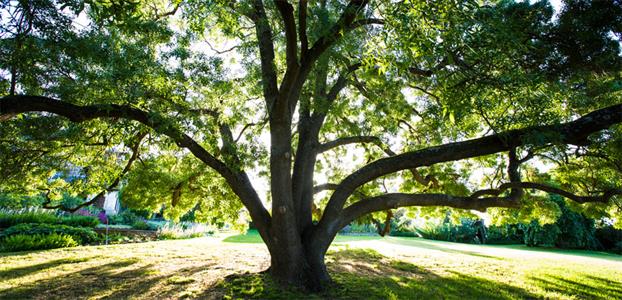
We have a Desert Ash that spreads 25 metres across and half this tree will shade over 200 people for weddings. To shade this same area would require the planting of over 17 ornamental pears.