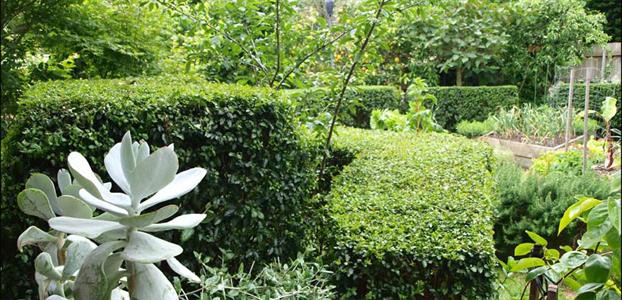
All designers approach projects differently. I believe the most important part of the design is uncovering what the client really wants from their garden.
Designed Landscaping
Landscape designer Keith Edwards explains how he designs.

My landscape designs are strongly influenced by two ladies who I believe to be two of the most brilliant minds in this field and also the most influential of their time: Gertrude Jekyll and Edna Walling.
The brief
Designing a garden for someone else starts with procuring a brief, and this is more than just a few simple yes/no questions. Before we meet, I ask them to spend some time gathering information about what they want, this is often in the form of a written and pictorial scrapbook of thoughts, encompassing everything they want or have seen from other gardens, magazines or books.
This is a wonderful exercise to do if you are planning on renovating your own garden too, because it helps to solidify the direction of the design and the overall feeling of the landscape.
These collections of ideas will often show a progression of ideas and a maturity to the theme that makes it easier to create the garden of their dreams.
Creating rooms
Garden rooms are not a new concept, in fact, in my initial design consultations I will sometimes share a quote from Edna Walling where she said, "A garden you can see all at once is not much of a garden at all". It’s important to ask yourself the question: Why would I venture out into the garden when I can see it in its entirety from where I am?
Creating intrigue is something both Walling and Jekyll did well. They created rooms that provided peaceful retreats and emotional pleasure, a feeling of romance, and gardens for intellectual enjoyment and intelligent design.
This is at the forefront in my mind when creating a design — how can I best use the principles of both these exceptional designers to bring the client the garden they want?
Getting the structure right
Providing visual strength, regardless of the gardens maturity or seasonality, is vital and this is achieved through structure.
Structure is the framework for the garden, and it can come in many forms. Hedging, walls, trees, pathways, terraces, mass plantings of single plant varieties and healthy lawns all provide much-needed structure to a garden — and this is achieved effortlessly with good, but uncomplicated design and carefully considered plantings.
Structure and space go hand in hand, and this is how garden rooms are created. Adding another dimension is the element of surprise, revealed only as you explore the garden. And yes, this is achievable even in a small garden.
Adding levels also creates interest, so a sloping block should be viewed as an opportunity, rather than a constraint. Retaining walls easily terrace a garden and create tiers for showcasing a wide variety of plants. Garden steps link the levels allowing visitors to embark on a journey of exploration, slowly revealing the garden's untold story.
The plants
The planting scheme itself should include a selection of plants and long-flowering perennials that complement each other. These can be selected using a ‘Colour Wheel’. They should always be planted in groups, never singularly, to allow the eye to move seamlessly across the garden and create a feeling of harmony. Selecting plants with differing forms, flower colours, foliage shapes as well as colours is also important. Transition areas help to link different flower colours and combinations, helping to blend elements of the garden from one room to the other.
Trees should be selected to provide a canopy, a vista, a cool shady area for a hot summer's day and, if applicable, for their ever-changing foliage through the seasons.
The use of screening trees and shrubs helps to bring depth to the garden, as well as providing privacy.
Trees and shrubs are also an important part of the home food forest, yielding a return on their investment to earn their place in the garden. Vegetables can be an ornamental feature, an edible necessity as well as bedding plants within the landscape, providing unusual seasonal colour and form, such as Five Colour silverbeet, Red Drumhead cabbage, giant red mustard, Bronze fennel and Romanesco broccoli.
The garden
Each garden is unique, just like its owners, and unearthing the right brief is critical to the success of the design and the landscape. I use the client's brief as my final destination, and the principles of Walling and Jekyll as the map to direct the design.
Many of today's gardens are dated by the influences of the time. With the demise of the local nursery that was stocked with a range of plants selected by nurserymen, we now see gardens full of Manchurian pears, magnolias, flax, yuccas, cycads, bedding plants and ornamental grasses, producing the xeriscape gardens of today.
I was fortunate to have been an early member of The Diggers Club, and it was the unusual and carefully selected garden-worthy plant varieties in the early catalogues that helped form the ‘plant palette’ I drew from in my early days as a garden designer — plants I still call upon today. They are timeless in their qualities and merits, just as any garden should be.