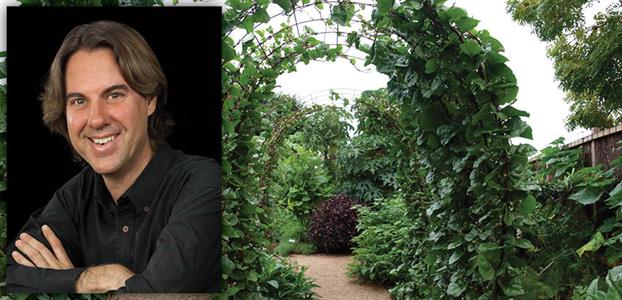
Last year Arno wrote an article in HMA News that led to discussions regarding the use of our ‘Hot’ zone to encompass the entire top half of our continent. What he had to say made sense, so we asked him to come and visit us so that we could take onboard his advice and improve our information for gardeners in the sub-tropical and tropical parts of our huge continent.
Arno is a climate sceptic in another, far more useful and justifiable way. He’s sceptical of the climate classifications that we use at Diggers to help gardeners make the right choices for planting and timing in your gardens.
Constructive criticism
Diggers plant survivability guide
The Diggers zone classifications are based on the USDA Cold and Heat Zones. This is a guide for basic plant survivability across Australia where we maintain that temperature is the main determinant of success or failure for all but annual plants. All plants are listed in our magazines and online with a HZ and CZ range that you can match to your location — simple! For more information on these zones go to the ‘Garden Advice’ section of our website.
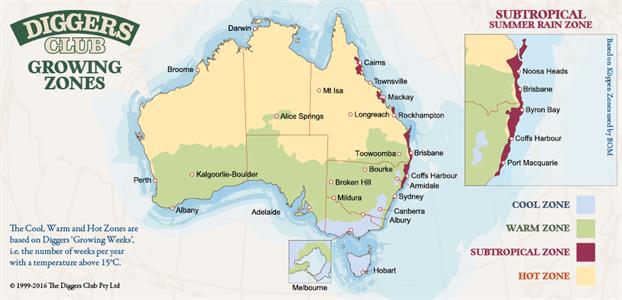
The challenge comes with the classification of the continent into areas where different activities are undertaken at different times of the year. Based on temperature data like the USDA method, we have used a ‘Growing Weeks’ classification for this where the average annual number of weeks per year where the temperature gets above 15°C is used to define three zones across Australia, Cool (9-20 weeks), Warm (21-38 weeks) and Hot (39+weeks).
This is a useful parameter when determining whether a temperate perennial will flower, fruit will ripen or a vegetable will crop in time, but does it apply to plants which prefer warmer growing conditions and is it useful for determining when to do what in our various climate zones?
Summer rainfall - A northern phenomenon
Arno’s advice to us was that the ‘Hot’ zone as we classify it is not a good guide for many northern gardeners. “There are two different Australias, one with predominantly wet winters and springs and one with predominantly wet summers and autumns”, says Arno, and the timing of the rainfall along with temperature is critical for seasonal planting timing.
For Arno, this summer rainfall combined with the high summer temperatures, means that there is a need to be judicious when selecting cultivars of lettuce, tomatoes, beans as some of these thrive, and others cannot grow in the summer as they rot in the ground or bolt during periods of heavy summer rainfall.
Arno explains that the USDA zone classification has the fundamental flaw that it doesn’t make any allowance for rainfall, either in annual average or seasonality. In drier areas where irrigation is used this may not be such a problem, but in many northern coastal areas with summer rainfall events of over 150mm in one hour and where averages may vary between 2 and 8 metres, the system fails.
His climate classification preference is a system devised by the Russian climatologist Wladimir Köppen where both rainfall and temperature are recorded and seasonality is considered. “In the 1960’s, at the height of the Cold War, the US Government were never going to accept a Russian climate classification, so they invented their own”, says Arno. The broad Köppen classification has 6 zones for Australia including two zones that have exclusively summer rainfall, the sub-tropics and true tropics and 4 zones that include both summer dominant and winter dominant areas.
We took this onboard and we are currently revising our sowing advice for vegetables in the humid sub-tropics. For the Cool and Warm areas on our Growing Weeks map we are confident, through our trials and experience, that these zones are a good working guide. Taking on Arno’s input, we have added a new Subtropical Zone following the Köppen classification to account for this summer rainfall climate (see map). We will be working on the ‘Top End’ next.
But the USDA Cold and Heat zones are the best way to illustrate the limits of a plants tolerance to the extremes of heat and cold, so please keep using the zones for your area as indicated on your membership card and on the address panel on your magazine for selecting the best fruit trees, perennials and shrubs for your area.
In addition to this if you live in Northern NSW and Southern QLD, thanks to Arno, we now have a zone that relates to you. Keep your eye out as we roll out the info for this new zone over the coming year.
Arno is working with Diggers Trials Manager, Ian Magnus, sharing Australian heirloom vegetable varieties from his own collection with us and growing out some the Diggers collection in his sub-tropical climate.
The dry winter and spring months are good growing conditions for the Mediterranean and high-elevation tropical vegetables. These include beetroot, capsicum, chicory, chilli, corn, eggplant, green beans, loose leaf lettuce, pumpkins, radish, rocket, silverbeet, tomatoes, zucchini.
By mid August to September, the temperatures in the sub-tropics start to escalate rapidly. The cloudless skies, intense sunlight and low humidity can burn and desiccate delicate young seedlings so watering and a bit of shade protection are vital at this time.
All this changes when the ‘Wet’ arrives between late October and January. With its heavy downpours (300mm in one day is not unheard of) high humidity, cloudy skies and diffused light, the gardener must respond to a completely different set of issues. Plants will now require good drainage, air movement and an adequate supply of nutrients.
During late spring and summer (as temperatures rise) we want to grow tropical vegetables, plants from Africa, Central and South America, South East Asia, India and South Pacific.
Climbing varieties are also a much better option for high production in small spaces (vertical growth) and less subject to disease during wet weather. Whenever you have a choice, (for example green beans, zucchini) plant the climbing rather than dwarf cultivars. Climbing vegetables include beans (lablab, winged, snake and ‘Purple King’ beans), squashes and gourds (zucchini, choko, cucumber, luffa, snake gourd, New Guinea gourd), and Malabar spinach.
Other reliable vegetables include amaranth (Chinese spinach), Ethiopian cabbage, corn, ‘Australian Gold’, ‘Oakleaf’ and Asian lettuce, cherry tomato, kailan, rosella and pumpkin. Many of these plants will need to be planted by mid spring. I take my cue when the nights start to warm and the coconut oil in the kitchen goes from a solid to a liquid.