
Manuka honey: is it food or a medicine?
Penny Blazey reviews the history of this renowned honey.

Bees have existed all over the world for millions of years but their relationship with humans only started thousands of years ago.
Indigenous people like the Australian Aborigines would raid the small honeycombs of native bees in the forest trees or the river banks.
These original people not only used honey as a food, they also used it as a medicine on their wounds and burns. In his book Manuka - the biography of an extraordinary honey, the author Cliff Van Eaton describes the story of beekeeping in many diverse ancient cultures including those in India, China and South America.
The honeybee originated and was domesticated in Europe and Africa where humans made skeps or hives for them to live in. Stingless native bees lead solitary lives and differ from honeybees who socialise in larger colonies, producing surplus honey that humans can harvest. Honeybees did not exist anywhere else in the world until the European colonists took them with their livestock to the Americas and Australasia, where beekeeping commenced for the first time.
The honeybee was introduced into New Zealand in 1839 by the aptly named Mary Bumby. She had managed to keep alive two colonies of honeybees in two small skeps for seven months on the long journey by ship from England! She arrived with her brother, Rev. John Bumby, at a mission station in Mangungu on the North Island, where manuka honey of the best quality is still harvested today. These early bees were European blacks (Apis mellifera mellifera) and those that escaped went feral in the forest trees because they were hardy enough to survive the warmer winters.
Later in the 1870s Isaac Hopkins introduced the yellow Italian honeybee (Apis mellifera ligustica) which was gentle and less likely to sting, but also produced copious crops of honey so it quickly replaced the European blacks as a domestic bee.
The Italian bees were more dependent on humans to keep and feed them in hives, especially if the nectar was scarce in winter or spring. All the bees thrived on the nectar and pollen of the widespread native bush manuka (Leptospermum scoparium), a species of tea tree also found in Australia.
There were around 75,000 hives owned by 15,000 beekeepers in New Zealand in 1906. In 1915 the government began to set grade standards for the colour of all the different honeys that were sourced from native flowers as well as clover and heather. The latter two were considered to be of the highest grade because they were the lightest or whitest.
The darker honeys were considered to be the lowest grade. The darkest was manuka honey, which fetched only half the price of the top honey made from clover. Manuka differed from other honeys in a number of ways. Firstly, it has a wide range of colour shades — honey from the South Island is lighter than that produced in the North Island. Secondly, manuka is very difficult to extract from the hive, making it more expensive to produce.
In 1991 a biochemist called Peter Molan, a senior lecturer at the University of Waikato, did an experiment with his friend Kerry Simpson — testing the antibacterial properties of three honeys after the hydrogen peroxide (something honey produces when it is diluted) was eliminated by an enzyme called catalase.
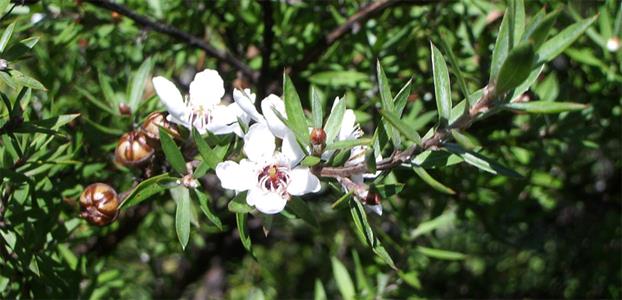
LEPTOSPERMUM SCOPARIUM IN FLOWER
It was through this experiment that the antibacterial properties of manuka honey were discovered. In November 1991 a press release was issued about the wound healing potential of the honey, ending with a quote by Peter saying, “It is clear that manuka honeys have qualities that surpass any other honeys.”
Suddenly journalists from all over the world wanted to find out about this honey from New Zealand, especially after several television programs showed the miraculous recovery of patients with wounds and ulcers that wouldn’t heal until they were treated with manuka honey. At last people took an interest in manuka and asked for it in stores, where it was mostly sold in bulk as bush honey.
The big beekeeping companies in New Zealand, like Berrys, Airborn Honey and Comvita, scrambled to compete for the new levels of demand for the product. Later, Comvita became the biggest bee-products company in Australasia by promoting the medical properties of manuka honey.
Peter Molan developed a wound dressing that made honey-like rubber so that it did not drip out of bandages.
This invention, called an alginate wound dressing, was taken up by Comvita who passed the brand and dressings on to Derma Sciences in a joint venture with an American company which now sells the Medihoney wound care range very profitably.
Further research was pursued at Waikato University where different varieties of honeys were tested against the seven most common species of bacteria found in wound infections. They were all effective, but manuka proved to be the most superior when it killed the bacteria of Staphylococcus aureus.
In 1998 the New Zealand Ministry of Health refused to let any retail packs make reference to the antibacterial activity of manuka honey as it was a food product.
Peter Molan and Bill Floyd, marketing manager for the bee keepers, solved this problem by using an acronym like SPF ratings on sunscreens and called it UMF standing for ‘Unique Manuka Factor’.
Ratings are displayed on the front of manuka honey jars (see photo above), showing the level of antibacterial activity of the honey inside them.
However, Peter Molan found that not all manuka honey had high levels of the special antibacterial properties that made it famous. It was necessary for the beekeepers to get their honey tested. In 2008, Thomas Henle from Dresden Technical University found the elusive compound, MGO, that was responsible for unique antibacterial activity in manuka honey.
Another compound involved called DHA, that worked together with MGO, was discovered a couple of years later by researchers at the University of Waikato. Companies in New Zealand now use two different measurements — UMF and MGO — on their labels to market manuka.
While hive numbers are going down in the United States and Europe, partly due to varroa mite, the number of hives in New Zealand increased from 290,000 in 2005 to over 450,000 in 2013. The value of honey exports from New Zealand has grown by 30% between 2000 and 2010. Both these figures are largely due to manuka sales, which are now worth over $140 million a year.
So manuka has gone from being the dark honey with the lowest value, to being the star of the nation, worth at least triple the value of most other honeys. What a story!
