
Living on the edge
The challenges of protecting our bushland and neighbouring communities. With Jeremy Francis, Creator of Cloudehill gardens.

June 9, 2021: climbing out of bed, my wife, Valerie, was saying “I was kept awake all night by falling trees”.
I was thinking ‘Surely just a branch or two’ until I noticed the view from our kitchen window. Past our garden, part of the forest was no longer there. Dozens of trees were missing. Those next hours, I was to find three houses within 200 metres were badly damaged and one turned to matchwood by two giant fallen trees. Altogether 76 houses in Victoria’s Dandenongs had been demolished and another 92 damaged. For hundreds of metres along one Kalorama street, not one building had survived.
Curiously the street nearest us is Bella Vista Crescent. This is a street thick with dangerous trees and where three houses were damaged, yet the name is clue to the fact that the houses, built in the 1960s and ’70s, are older than the trees. What’s more, there are dozens of streets in the Dandenongs where this is true – Bonnie View Road, Sunset Avenue, Grandview Grove, Two Bays Crescent, and many more.
Risks of a regenerated forest
What happened on June 9 is but one manifestation of a fundamental risk people in the Dandenongs live with: their proximity to immensely tall timber trees, which often fall down and also burn in catastrophic fires. Prof. Stephen Pyne of Arizona State University, a world authority on the subject, ranks the Dandenongs as the worst ‘blow-up’ area he has seen. This has arisen because forest trees have been allowed to infiltrate what had previously been a fire-safe residential area. However, this didn’t happen overnight and took nearly 80 years.
From the mid-19th Century, the Dandenongs were almost entirely clear felled, with occasional trees left in the wet gullies. The deep volcanic soils along the ridges became small farms and market gardens. In the years after WWI, the area became a ‘hill station’ retreat. Dozens of guest houses were built, nestled in gardens full of rhododendrons and deciduous trees. There were occasional fires but they were never more than a nuisance. The idea that people might die in them was unthinkable because the landscape was simply not conducive to a dangerously hot fire.
After WWII, farms and nurseries were divided into building blocks and gradually the trees spread out from the gullies and grew back. The first fire dangerous enough to cause deaths was in 1962. Eight died in the big fires of that summer. Even in the 70s though, much of the mountain was clear. People drove from Melbourne to enjoy the views. These vanished in the 1980s and 90s, with trees thickening to the point that now we see street after street overwhelmed by a regenerated forest.
In 1997, three were killed in the Ferny Creek fire, and the bullet we missed on Black Saturday, when at the last moment the Ferntree Gully fire was controlled, would probably have increased the death toll by many hundreds if it had got away that day.
Fire dangerous forest trees and housing do not mix. Right now the insurance industry is saying this. Premiums are rocketing. Many are struggling to get insurance and it’s not just a problem in the Dandenongs. Throughout peri-urban Australia, the interface of suburbia and the bush, people are finding it hard to renew insurance and, of course, heavily treed suburbs without insurance means the ‘leave early’ policy is dead.
Royal Commission findings
The way out of this mess was illuminated in the 2009 Bushfire Royal Commission. Research conducted by Chen/McInerney for the commission found that that 85% of buildings destroyed by bushfires in Australia between 1939 and 2009 were within 100 metres of ‘bushland’. A further 10% were 100 to 200 metres away and from there ‘house-to-house’ ignition (as happened in Hobart in 1967 and in Canberra in 2003) becomes the big problem. This research demonstrates that by managing vegetation out to 100 metres from buildings, we reduce their risk of burning by 85%, and this can make peri-urban Australia defendable.
The Commission’s findings make plain that separating bushland from housing interface communities will be safer and will also enable us to manage bushlands as the First Nations Peoples did. Fire-resilient bushlands must be regularly burnt in ultra-cool fires – to do this we must use buffers to disentangle them from residential areas. Our residential gardens should be filled with high moisture content, low volatile oil content shrubs and trees. Fire resistant trees are critical. Poplars and oaks are ideal to screen radiant heat and extinguish flying embers.
The more fire-safe our gardens, the easier it will be to cool-burn adjacent bushlands and the more fire-resilient they will become.
Change is critical
This is a huge change to how we live in Australia. It will need support from every level of government and it needs to happen quickly. All around the world, weather is becoming chaotic. England has suffered record heat this summer and temperatures reached almost 50°C in Western Canada last year. There have been giant fires in Siberia and earlier this year temperatures jumped to 40°C above normal in Antarctica. I think the chances of similar happening in Victoria in the next five years are greater than one in two. And if it does, I reckon the chances of the Dandenongs surviving are probably less than one in two.
We must tackle this problem and do so knowing that the safer our houses and gardens, the safer our bushlands.
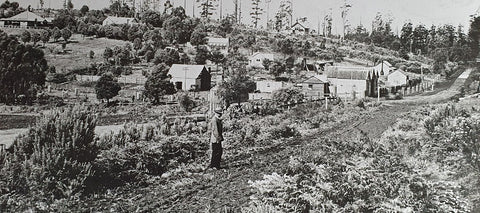
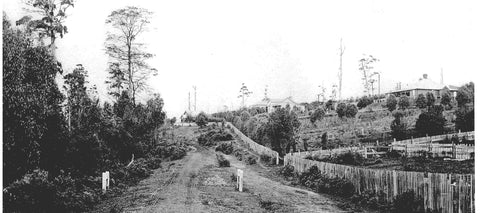
Early 20th century photo of houses and cleared paddocks in the Dandenong Ranges.