
Living alongside trees
Understanding how tree roots behave helps gardeners plant the right way. With Greg Moore, OAM Senior research associate of Burnley College and University of Melbourne.

Tree root systems are often misunderstood. Many people think that large trees must have large tap roots that penetrate deep into the soil, but for many large trees, their root systems are shallow and spreading. This root architecture results from the way in which tree root systems develop.
When a tree seed germinates in undisturbed natural soils, the young root tip (radicle) emerges and usually develops into a tap root. In many Australian species, it is not uncommon to find a 20mm tall seedling with a primary root of 150–200mm in length, which develops as a tap root, anchoring the young tree and providing the necessary water and nutrients to facilitate seedling growth. This tap root provides the framework from which lateral roots develop.
In many tree species, however, the tap root could be considered a juvenile characteristic, which persists for the early establishment phase of a tree’s life cycle. The tap root descends almost vertically and soon reaches soils that are compacted, and low in oxygen, organic matter, water and nutrients.
Furthermore, the nutrients in the soil surrounding the tap root are soon exhausted and soil oxygen decreases rapidly with depth, which explains why 95% of the absorbing roots are so close to the surface and why tap roots die back.
Think lateral
The tap root, having served its purpose, usually dies back, leaving the spreading lateral roots to perform the roles of absorbing nutrients and water and of anchoring the tree.
In many urban trees, the propagation techniques of growing trees from cuttings or growing seedlings in shallow seed trays and then potting-on through successively larger containers, often means that there is no tap root even in young trees.
The root systems of mature trees tend to be spreading and relatively shallow (refer to the top illustration opposite), consisting of a shallow, spreading root plate, as opposed to a rootball. The root plate of lateral spreading roots is complemented by the presence of descending (or vertical or sinker) roots, which tend to occur around the base of the tree or close to the trunk. Descending roots occur across the root plate, but there are more of them concentrated around the base of the trunk where they are often confused for tap roots.
Digging deeper
Descending roots closer to the trunk tend to grow deeper in the soil than descending roots further from the trunk, which are shallower and smaller in diameter.
While the lateral roots are often within 200–300mm of the soil surface, descending roots may grow to depths of 1,000mm or more. They persist for a number of years and at maturity may be 100–150mm in diameter before they die back and are replaced. Both the root plate and the descending roots are important in tree stability.
Prevailing wind impact
Size matters in the development of tree root systems. Much of the root mass is located in a few large structural roots that are typical of most trees and these, along with the larger woody transport roots, stabilise the tree. There are many models of root plate development and they are often depicted as being circular around the tree trunk.
However, this is a simplified approximation, as root plates usually have about 60% of their roots in the direction of the prevailing wind (see bottom illustration opposite) and so real root systems are more often elliptical. Furthermore, trees growing subject to directional winds tend to have windward roots that are smaller in diameter but longer and more branched at greater distances from the trunk than leeward roots.
On the leeward side, the roots are shorter, thicker and tend to have more descending roots. Thus the root plate is more likely to be elliptical but skewed to the windward side of the trunk. Damage to roots anchoring the tree on the windward side by trenching or construction works is more likely to lead to windthrow where the root plate tilts.
There is great variation in the depth to which roots penetrate, but in many urban soils capacity is limited to no more than 750–1,000mm or less by site and construction activities that have altered and compacted the soil profile. Trees can be windthrown in very strong winds, especially when heavy rain has saturated soils reducing soil strength.
The combination of heavy rain that saturates soil (reducing the strength of the connection between soil and tree roots) followed by strong winds may see trees fail, but even then the windthrown tree is usually the exception rather than the rule.
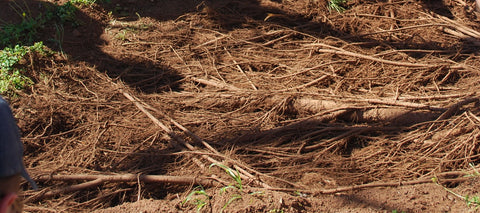
Exposed Shallow lateral spreading roots
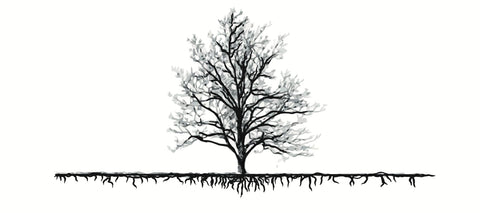
Tree roots spread wide and shallow
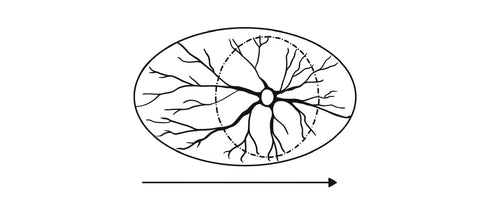
Tree root growth in the direction of the prevailing wind