
The modern Australian garden
Garden designers are matching plant choices to local climate and living spaces, leading to greener cities and suburbs. With Teena Crawford Horticultural consultant, botanical tour guide and garden guru.

Garden designers are matching plant choices to local climate and living spaces, leading to greener cities and suburbs.
Gardens across the world have evolved over the last 250 years, but it is in the most recent times that the Australian garden has developed its own identity and style.
No longer do gardens reflect our heritage influences, traditions or how our parents tended their patch. Driven by strong, talented landscape designers we see gardens created sympathetic to the environment and climate and suited to our relaxed Australian lifestyle.
Native plants
It was not that long ago when you would rarely see landscaped gardens with even a smattering of native plants. Instead, gardens were filled with exotic plants including English box, iceberg roses, and hydrangeas. This was often driven by clients’ prejudices. They did not want a native garden that was too wild, bland and unattractive. Much of this was an overhang from the 70s and early 80s when there was a flurry of native gardens planted with no thought to any ongoing aftercare. The gardens became an unattractive wild mess. These gardens were destined to fail.
Today, designers have more knowledge of native plants’ characteristics, growth habits and ongoing maintenance. This has led to better use of natives in the landscape. Plants are combined not just for their suitability for the landscape but also how they complement each other, resulting in a coherent, well-planned garden, which is both practical and beautiful.
With the advent of Plant Breeders Rights (PBR), much attention has been given by plant researchers and breeders to develop the very best new varieties of native plants for garden making. The most desired characteristics of plant species have been bred into a profusion of new varieties expanding the plant palette available. Garden designers are utilising these plants to further enhance the gardens they create.
Global plants
Driven by a deeper understanding and respect for the environment and more knowledge of plants and their requirements, garden designers are now more considered when selecting non-Australian plants for their gardens.
Garden designers utilise plants from other parts of the world which have a similar climate to Australian conditions. For the southern and inland parts of the Australian continent, we look to the Mediterranean, South Africa, California and Chile for plants that have evolved to flourish in hot, dry summers and cold, wet winters. Endemic plants from these regions provide the designer with a broad plant palette to draw from when designing.
In northern Australia, designers look for inspiration from other parts of the world, including India, South America, and Florida, USA. Central areas of Tasmania have a climate more akin to Britain. Northwest Tasmania is drier, so Californian plants are more suited.
Mixed gardens
Garden design has become more sophisticated. Knowledge of individual plants and where and how they naturally grow provides the garden designer with essential information when selecting plants for a garden.
Whether the plants are endemic to the area, Australian natives or plants originating from the other side of the world, the most suitable plant palette can be selected for the local conditions. The result is a ‘multi-cultural’ or ‘mixed’ garden reflecting our diverse, modern Australian society.
Greening areas
Further to plant choice, it has been recognised by many that plants are our ‘saviour’, maintaining and enhancing the liveability of our cities. Garden designers are greening both public and private spaces more creatively than ever.
Penthouse gardens are a common feature of our cities. No longer do they just contain a few plants in pots. Rooftop gardens can have it all, vegetable gardens, tree canopies, shrubbery and even a lawn. Building rooftops are being transformed into lush communal gardens for all residents and office workers. The gardens contribute positively to the size and diversity of our urban forest, helping to green our cities.
Where there is little or no ground area for gardens, vertical spaces are being clothed with plants. Green walls are used to soften building facades. Wire structures clothed in deciduous climbing plants create walls of seasonal foliage cover. Balconies are planted with trailing plants, which veil softly down the facade.
Plant solutions
Garden designers are looking to plants to solve design issues. Forget the trellis or blue board screen to soften an ugly view. Columnar trees, pleached hedges and vertical wires clothed in climbing plants provide a greener and more aesthetically pleasing result. Pergolas draped in vines or clusters of deciduous trees forming a living umbrella have replaced the traditional garden gazebo.
Plants are the future
Architecture and building techniques have become very sophisticated, but it is the green component, the ‘plants’ that are integral to a building’s success and liveability. An even greater emphasis on good planting design is crucial in improving our lives.
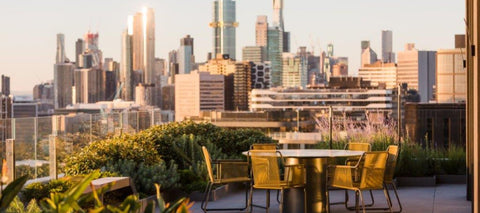
City Rooftop - Lisa Ellis Gardens
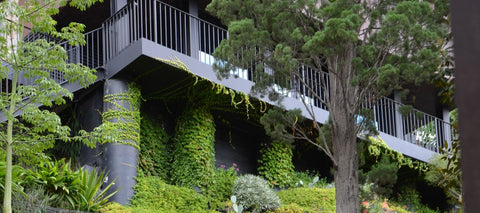
Melbourne garden, eckersley garden architecture
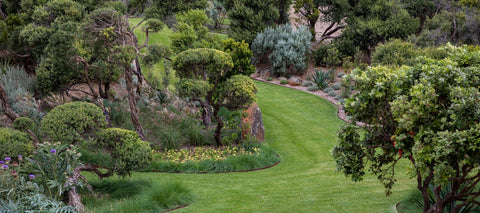
Yarra Valley garden, Lisa Ellis gardens